The Psychology of a Clickable Link: Decoding User Behavior
Why do some links get clicked while others are ignored? We analyzed the cognitive biases and heuristics that drive user behavior online.
The internet is a battle for attention, but the click is the victory. To win the click, you don't just need a good headline; you need to understand the subconscious triggers that fire in a human brain milliseconds before a finger taps glass. It's not luck. It's neuroscience.
Table of Contents
The Information Gap: Creating Neourosity
In 1994, behavioral economist George Loewenstein published a paper creating the "Information Gap Theory." He argued that curiosity is like a mental itch. When we are aware of a gap in our knowledge, we feel an emotional deprivation that compels us to seek information to close the gap.
Your link is the bridge.
Bad: "Here is our quarterly report on sales." (No gap. I know exactly what it is. Boring.)
Good: "The one metric that doubled our Q4 sales." (Gap created. What metric? I need to click to close the loop.)
Using a short link slug like /secret-metric or /q4-growth-hack reinforces this gap.
Predictability vs. Mystery
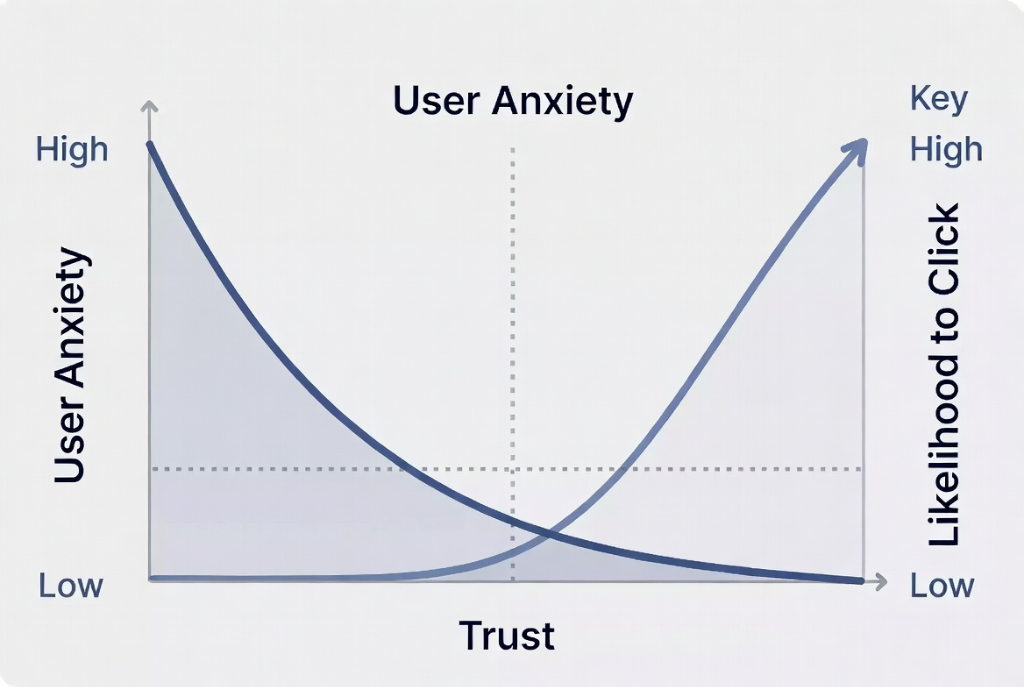
This creates a paradox. While curiosity relies on mystery, safety relies on predictability. If a user feels the destination is dangerous (malware, spam, shock content), their self-preservation instinct overrides their curiosity.
The winning formula is Branded Predictability + Contextual Mystery.
Using a custom domain (link.brand.com) satisfies the safety requirement. The user knows the sender.
Using the slug and the surrounding copy helps create the mystery. You need both. A mystery link on a mystery domain is just a security risk.
Cognitive Load: The Beauty of Short URLs
Our brains are cognitive misers. We try to spend as little energy as possible processing information. A long, garbled URL with 50 parameters (example.com/p?id=123&session=999&ref=...) looks like visual noise. It requires processing power to ignore.
A clean, short URL (go.acme.com/buy) is visually fluent. It feels easier to engage with. "Processing Fluency" theory states that we view simple, easy-to-understand stimuli as more trustworthy and truthful than complex ones. By shortening your links, you are literally making your offer feel more honest to the primal brain.
Visual Trust Signals
What makes a link look "official"?
- HTTPS: The lock icon is non-negotiable.
- Brand Match: The domain matches the handle sharing it.
- Keyword Relevance: The words in the slug match the topic (Semantic Priming).
The Bandwagon Effect
Links that appear "worn" or "traveled" get more clicks. This is why seeing "500 likes" on a post makes you more likely to verify the content. In link contexts, this manifests as social proof surrounding the link.
Experiment idea: Share a link saying "Join 4,000 others who read this." The social weight overcomes the inertia of the click.
Common Mistakes to Avoid
- ✕ Over-promising: Creating an Information Gap you can't fill (Clickbait). If your content doesn't deliver the payoff, you destroy the trust for the *next* link.
-
✕
Generic Slugs: Using
/a1b2cwhen you could use/summer-sale. You are wasting prime psychological real estate.
Frequently Asked Questions
Do capitals matter in links?
Technically, the path after the domain CAN be case-sensitive depending on the server. To avoid user confusion, it is best practice to always use lowercase and hyphens (kebab-case).
Are QR codes "clickable"?
Psychologically, yes. A QR code is a physical link. The same rules of trust apply—context is everything. A QR code on a sticker in a dive bar bathroom is low trust. A QR code on a receipt is high trust.
Ready to put this into practice?
Start creating branded links today and watch your engagement soar.
Get Started for Free